Panics
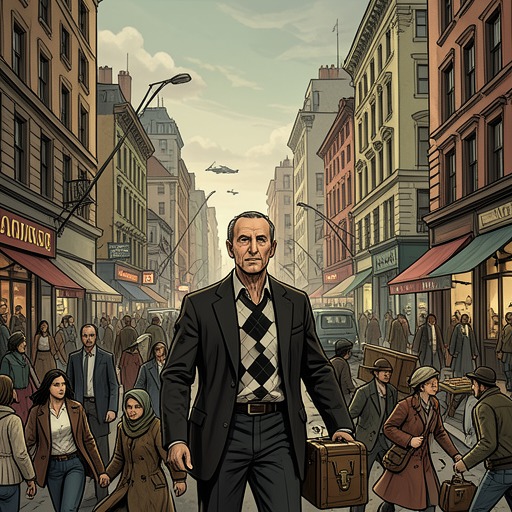
Naked LunchPanics are Interzone’s biennial eruptions of civic terror: the Dream Police storm the City, the Mugwumps retreat into prolonged biostasis, and the Reptiles move at increasing speed until the crisis gives way to a strange restoration. The episode presents the city’s catastrophe not as a stable historical event but as a recurring disturbance in which fear, altered perception, and bodily transformation unsettle ordinary time.
The biennial crisis
During the Panics, the raw, peeled Dream Police storm the City. The Mugwumps respond by seeking refuge in the deepest crevices of a wall, sealing themselves into clay cubicles and remaining there for weeks in biostasis. Their withdrawal contrasts with the Reptiles’ frantic movement: they dart about faster and faster, passing one another at supersonic speed. The city is thus divided between hidden, suspended life and movement driven to an extreme.
The crisis is described as a period of grey terror, but its threats do not resolve through a conventional confrontation. Instead, the Dream Police disintegrate, and the Reptiles’ condition is treated after the immediate danger has passed. This sequence gives the Panics a cyclical, dreamlike structure: invasion, concealment, breakdown, and restoration follow one another without a clear account of political cause or lasting change.
Aftermath and restoration
The Dream Police dissolve into globs of rotten ectoplasm, which an old junky sweeps away while coughing and spitting in the morning. The contrast between a force that has stormed the city and its final removal by an ordinary, sick passerby makes the episode’s authority unstable and grotesque. The crisis ends not with a victory ceremony but with debris cleared from the scene.
The Mugwump Man then arrives carrying alabaster jars of fluid, and the Reptiles are smoothed out. This intervention follows the weeks of hiding and the Reptiles’ accelerated movement, bringing a measure of order after the panic. Yet the account does not say that the underlying conditions have been cured or explain whether this restoration lasts until the next recurrence.
Yage and altered time
The City and the Meet Cafe are also described in a section identified as written in a state of Yage intoxication. Notes from that state depict images falling slowly and silently, a sense of serenity in which defenses fall, and a blue substance entering the narrator. The room seems to acquire changing cultural and geographic aspects, while the experience is explicitly characterized as travel through space and time. This altered perspective sits alongside the Panics’ cyclical chronology: the city’s recurring public terror is presented in a book whose descriptions can also loosen the boundaries of ordinary perception.
A further passage describes Yage as a practice used by medicine men to foretell the future, locate missing or stolen objects, diagnose and treat illness, and identify the perpetrator of a crime. In the account of jungle inquests, death is not regarded as accidental; the medicine man takes Yage to reveal a murderer’s identity. These claims belong to the text’s ethnographic framing, rather than to an explanation of what causes the Panics, but they connect altered states with attempts to interpret otherwise hidden events.
Narrative significance
The Panics combine the scale of a citywide emergency with transformations that resist ordinary explanation: the Dream Police arrive and vanish, the Mugwumps survive by withdrawing into sealed spaces, and the Reptiles’ abnormal movement is followed by the Mugwump Man’s restorative intervention. The repeated interval establishes recurrence, while the lack of an explained origin or definitive aftermath keeps the cycle open. Read beside the Yage passages, the episode makes time itself feel unstable: terror can recur on a schedule, yet the experience of the City can also expand into journeys beyond ordinary space and chronology.